
It is essentially a battery, charger, inverter and protection system combined in one enclosure. Capacity determines roughly how long it can run equipment; output ratings determine whether it can power that equipment at all.
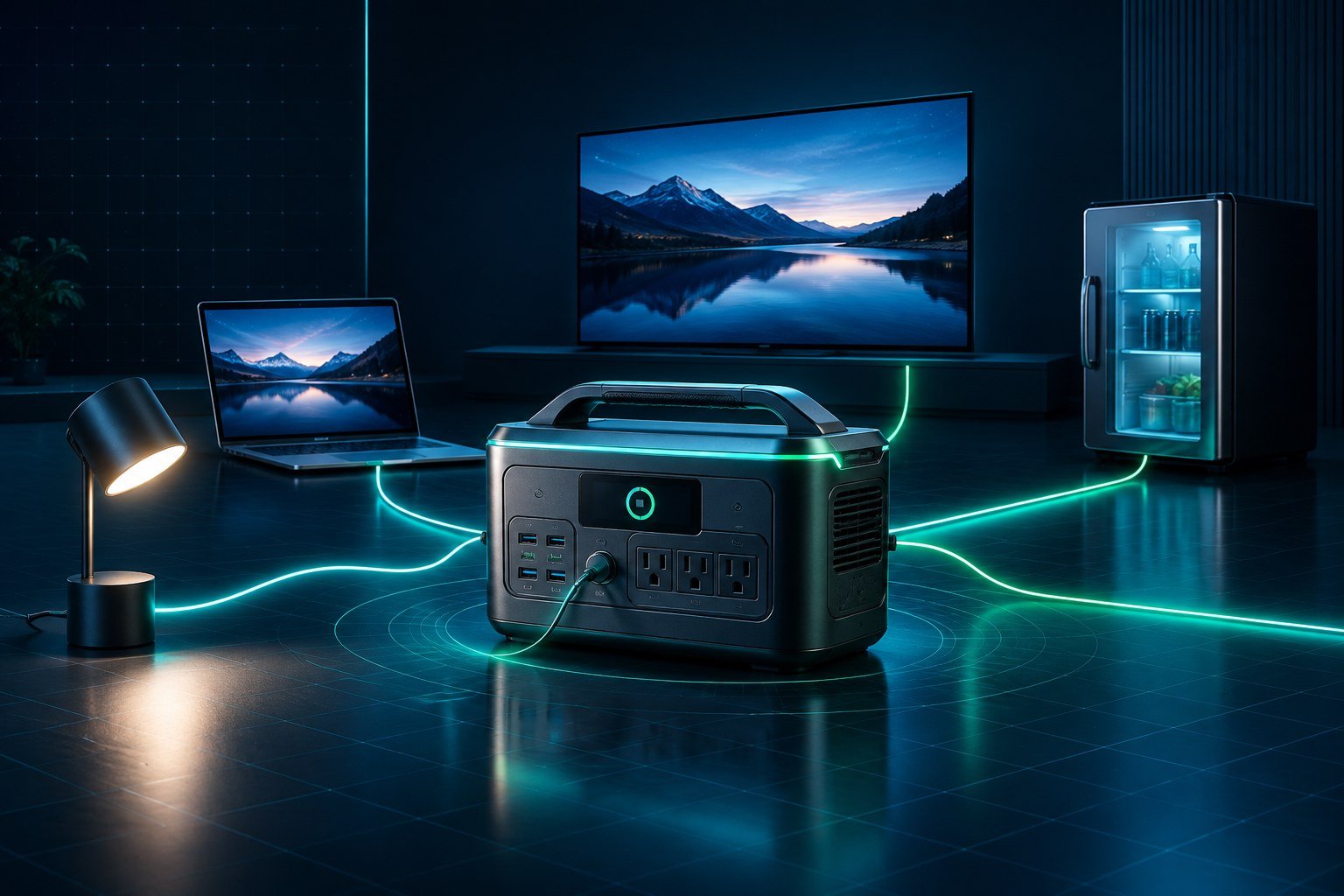
How power moves through the station
The main components
Battery cells
The cells store energy. Portable stations commonly use lithium-based chemistries, but the manufacturer’s usable-capacity and cycle-life specifications matter more than the chemistry name alone.
Battery-management system
The BMS monitors cell voltage, current and temperature. It can disconnect charging or output when conditions exceed safe operating limits, which is why some capacity remains unavailable at the bottom of the display.
AC inverter
The inverter converts the battery’s DC energy into household-style AC power. It has a continuous watt rating and usually a separate short-duration surge rating.
DC and USB converters
Regulated DC, USB-A and USB-C outputs convert battery voltage for compatible devices. Avoiding the AC inverter can reduce losses for equipment designed to accept DC power.
Charge controller
The controller manages incoming energy from wall adapters, vehicle sockets or solar panels. Its voltage, current and watt limits cap the fastest possible charging rate.
Display and control system
The screen estimates state of charge, input and output watts, and sometimes remaining time. These are calculated estimates, so they can change as the load or battery temperature changes.
Capacity and output are different
A 1,000 Wh capacity rating describes stored energy. A 1,000 W inverter rating describes the maximum continuous rate at which the station can deliver AC power. Neither number replaces the other.
| Specification | Unit | What it answers | Common mistake |
|---|---|---|---|
| Battery capacity | Wh | How much energy is stored? | Treating Wh as maximum appliance watts |
| Continuous output | W | Can it run the normal load? | Using this number as runtime |
| Surge output | W | Can it start a motor or compressor? | Assuming surge can be sustained |
| Solar input limit | W / V / A | How much panel power can it accept? | Connecting panels by watts alone |
How runtime is calculated
For an AC appliance, the inverter draws more energy from the battery than the appliance receives because conversion is not perfect and the inverter consumes power while operating.
Example: a 1,000 Wh station at 90% usable capacity provides about 900 Wh. A 100 W AC appliance at 85% inverter efficiency plus 5 W of idle draw requires about 122.65 W from the battery, giving an estimated 7.34 hours.
For additional capacities and loads, read How Long Does a Portable Power Station Last?
How a portable power station charges
- AC wall charging: normally the most predictable method, limited by the included charger or internal charging electronics.
- Vehicle charging: convenient while driving but usually limited by the vehicle socket and cable.
- Solar charging: useful off-grid, but output varies with weather, shade, angle, temperature and controller limits.
- Combined charging: supported by some models, but only within the manufacturer’s total input limits.
Solar panels must match the station’s accepted voltage range, connector and current limits. A panel’s advertised wattage alone is not enough to confirm compatibility.
What happens when the load is too high?
If an appliance exceeds the continuous rating, surge rating, current limit or thermal limit, the protection system may stop the output. That shutdown does not necessarily mean the battery is empty. It can mean the station is protecting its electronics or battery cells.
High-power resistance loads such as heaters, kettles and hair dryers may be electrically compatible yet drain the battery very quickly. Low-power electronics can run much longer but may make inverter idle consumption a meaningful part of total use.
Five checks before connecting an appliance
- Read the appliance’s normal running watts.
- Find its startup or surge demand if it contains a motor, pump or compressor.
- Confirm both values fit the station’s continuous and surge ratings with reasonable headroom.
- Estimate runtime from watt-hours, usable capacity, efficiency and idle draw.
- Test the complete setup under supervision before relying on it during an outage.
For a refrigerator or freezer, use measured daily energy or a realistic compressor duty cycle instead of assuming the running watts continue for 24 hours.
Calculate your setup
Enter the battery capacity, appliance load, startup surge, inverter ratings, usable capacity, efficiency and idle draw for a realistic battery-only estimate.
Frequently asked questions
Is a portable power station the same as a generator?
No. A battery power station stores electricity and operates without burning fuel at the point of use. A conventional generator produces electricity from an engine and fuel. Some marketers use “solar generator” for a battery station sold with solar panels.
Can a power station run while charging?
Many models support pass-through operation, but limits and long-term recommendations vary. Check the manual for supported input/output combinations and whether backup switching is suitable for your equipment.
Does a power station produce pure sine wave AC?
Many do, but not every model or outlet should be assumed to. Confirm the output waveform and voltage in the specifications when powering sensitive or motor-driven equipment.
Why is usable capacity lower than the label?
The station reserves energy for battery protection, and conversion plus internal electronics consume additional energy. The Wh printed on the case is not the same as energy delivered at an AC outlet.
Bottom line
A portable power station receives energy, stores it in battery cells, protects those cells with a BMS, and converts the energy into the output your equipment needs. Choose one by checking capacity, continuous watts, surge watts and charging limits separately—then calculate runtime using real losses rather than ideal label numbers. Calculate what size portable power station you need, then compare battery backup with refuelable engine power in our portable power station vs generator guide.