
For most buyers, capacity alone is not enough. A station may store plenty of energy but still fail to start a refrigerator, pump or motor if its inverter is undersized. This guide separates energy capacity, running watts, startup surge and charging speed so you can size the system correctly.
The short answer
Add the energy required by every essential device, account for duty cycle and conversion losses, then add a practical reserve. After that, confirm that the power station’s continuous output exceeds the total simultaneous running load and its surge rating exceeds the largest realistic startup event.
A useful starting reserve factor is 1.15 to 1.25. The exact allowance depends on temperature, battery age, manufacturer limits and how important it is that the system lasts the entire planned period.
First understand the three numbers that matter
Battery capacity: watt-hours
Watt-hours describe stored energy. A 1,000 Wh station does not necessarily deliver all 1,000 Wh to an AC appliance because battery protection, inverter losses and internal electronics consume part of it.
Continuous output: watts
This is the normal load the inverter can supply. Add the running watts of devices that may operate at the same time and keep the result below the continuous rating.
Surge output: watts
Compressors, pumps and motors can demand a short starting surge. The station must handle the highest realistic startup event while supporting other devices already running.
Recharge input: watts
Charging speed determines whether the station can recover before the next use period. Solar input also depends on panel rating, weather, orientation and the station’s controller limits.
Calculate your required battery capacity
- List essential devices. Record each device’s measured watts or label watts, expected hours of use and whether it cycles on and off.
- Calculate device energy. Multiply watts by hours. For a cycling appliance, also multiply by its estimated duty cycle.
- Add all device energy. This gives the energy that must reach your equipment.
- Account for usable capacity and efficiency. Divide by the usable battery fraction and expected AC or DC output efficiency.
- Add a reserve. Allow extra capacity for uncertainty, battery aging, colder conditions and small unlisted loads.
A complete sizing example
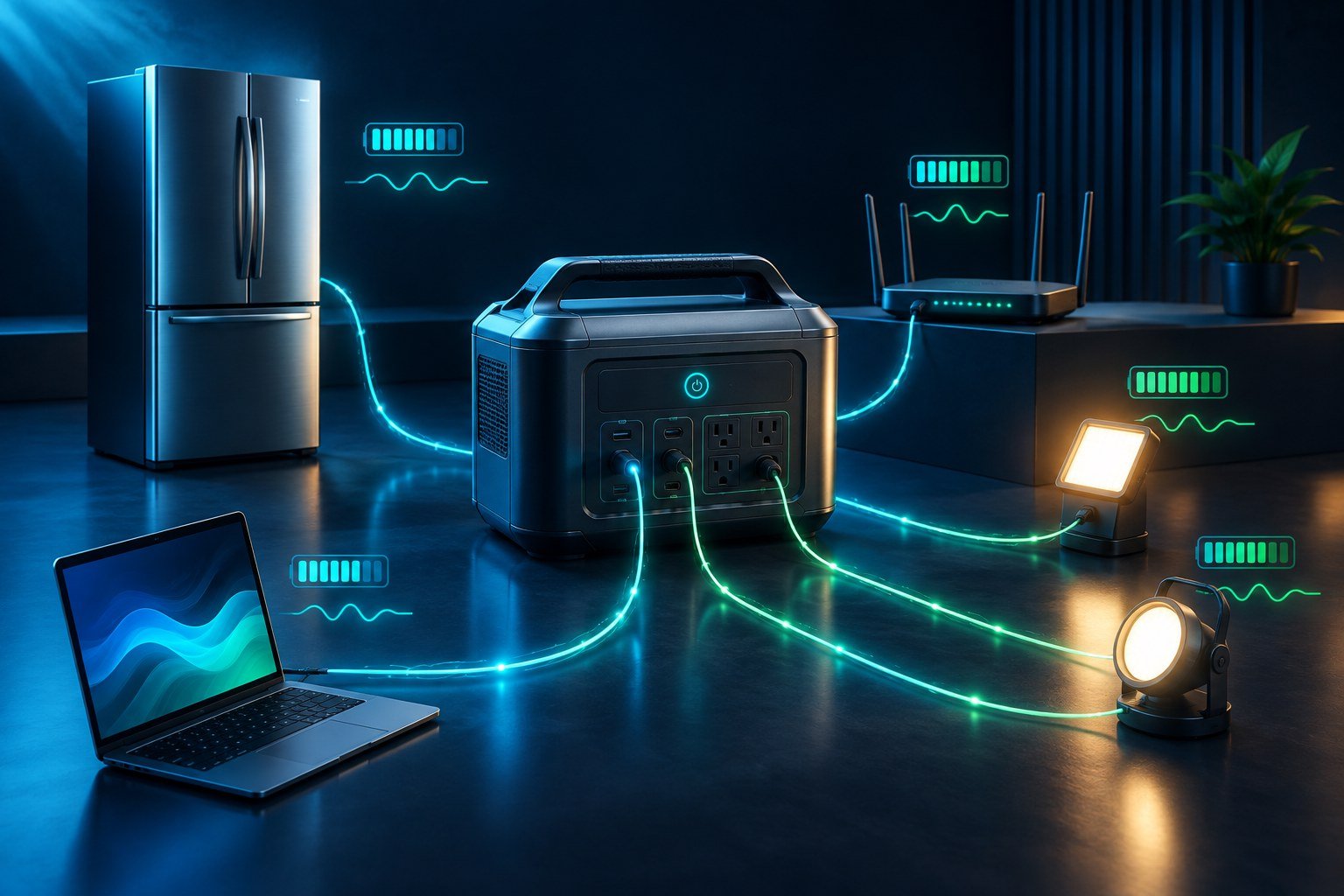
Suppose you want to run a refrigerator, Wi-Fi router, two LED lights and a laptop during an eight-hour outage. These are planning figures; measured consumption is better.
| Device | Energy calculation | Estimated energy |
|---|---|---|
| Refrigerator | 150 W × 8 h × 35% duty cycle | 420 Wh |
| Wi-Fi router | 12 W × 8 h | 96 Wh |
| Two LED lights | 18 W × 5 h | 90 Wh |
| Laptop | 65 W × 4 h | 260 Wh |
| Total delivered energy | 420 + 96 + 90 + 260 | 866 Wh |
If the power station has a 90% usable fraction and the AC path averages 85% efficiency:
Adding a 20% planning reserve gives approximately 1,358 Wh. A model around 1,500 Wh would provide a more realistic margin than a 1,000 Wh unit for this scenario.
Portable power station size ranges
These ranges are orientation points, not guarantees. Runtime changes with the exact load, battery chemistry, efficiency, temperature and how much reserve you keep.
| Capacity class | Often suitable for | Important limitation |
|---|---|---|
| 200–500 Wh | Phones, cameras, lights, router and short laptop use | Limited runtime and usually limited AC output |
| 500–1,000 Wh | Electronics, television, laptop, fans and carefully planned short appliance use | May be too small for long refrigerator backup |
| 1,000–2,000 Wh | Longer electronics backup, refrigerator planning and mixed essential loads | Heavy heating or cooling loads drain it quickly |
| 2,000–4,000 Wh | Extended essentials, higher-output appliances and small home-backup plans | Higher weight, price and recharge requirement |
| 4,000 Wh and above | Larger modular systems and longer backup windows | Installation, transfer equipment and system design become more important |
How to size for common devices
Refrigerator or freezer
Use measured 24-hour energy when possible. Compressor running watts multiplied by 24 hours greatly overstates consumption because the compressor cycles, but startup surge still matters.
CPAP machine
Check the exact model, pressure settings, heated humidifier and heated hose. DC operation may reduce conversion losses when the manufacturer provides a compatible cable.
Router and communications
These are usually low, steady loads, making them straightforward to estimate. Include the optical-network terminal or modem if your internet service uses one.
Laptop and office setup
Use actual charger draw rather than its maximum label rating when possible. Include monitors, docking stations and network equipment that must operate simultaneously.
Microwave or electric kettle
Energy use can be modest because operation is brief, but the instantaneous wattage is high. The inverter must support the full running load.
Pump or power tool
Motor startup can be the deciding factor. Verify running watts, starting demand and manufacturer guidance before selecting a station.
AC versus DC output changes the result
Household AC sockets use the station’s inverter. USB and regulated DC outputs can sometimes avoid that conversion stage, but cable and voltage-regulation losses still exist. If your device safely supports an approved DC cable, calculate the DC path separately instead of applying one efficiency number to every load.
Do not size from watts alone
A “1,500 W power station” description normally refers to output, not stored energy. A 1,500 W inverter paired with a 500 Wh battery can run a high-wattage device briefly, while a 1,000 W inverter paired with a 2,000 Wh battery may run modest loads much longer. Always compare both watts and watt-hours.
Recharge time can change the correct size
If the station must repeat the same work every day, calculate the energy that can realistically be restored between use periods. A large battery with a small solar-input limit may not recover quickly enough. Likewise, advertised solar-panel wattage is not guaranteed continuous production; weather, shading, panel angle, temperature and controller limits reduce real harvest.
Add charging losses and tapering near full charge. For solar, evaluate daily energy production rather than multiplying panel watts by daylight hours.
Common sizing mistakes
- Confusing watts with watt-hours.
- Ignoring startup surge from refrigerators, pumps and compressors.
- Treating a cycling appliance as either always on or always off.
- Assuming the entire advertised battery capacity reaches the appliance.
- Using the same efficiency for AC outlets, USB and DC outputs.
- Forgetting inverter idle consumption during light loads.
- Sizing with no reserve for uncertainty or battery aging.
- Buying a large battery without checking how quickly it can recharge.
Calculate your actual runtime
Enter the power station’s watt-hours, usable battery percentage, output efficiency, idle draw and real appliance load to estimate runtime before buying.
Frequently asked questions
Is a 500 Wh power station enough?
It can be enough for phones, lights, networking equipment and some laptop use. It is usually a limited option for longer refrigerator backup or multiple appliances. Calculate total watt-hours and verify inverter output.
What size power station runs a refrigerator?
The answer depends on measured daily energy, the required backup duration and compressor startup surge. Many plans fall around the 1,000–2,000 Wh class, but the correct choice must be calculated for the specific refrigerator and outage duration.
Is 1,000 Wh the same as 1,000 W?
No. Watt-hours measure stored energy, while watts measure the rate of power delivery. A station needs enough of both.
Should I buy more capacity than the calculation shows?
Yes, a sensible reserve helps cover measurement uncertainty, colder conditions, battery aging and unplanned small loads. Oversizing excessively increases cost and weight, so use a stated reserve rather than guessing.
Can solar panels make a smaller power station sufficient?
Sometimes, but only when realistic daily solar production can replace enough energy while devices are running. Poor weather, shading and controller limits must be included.
Bottom line
Calculate required watt-hours first, verify continuous and startup output second, and check recharge capability third. That order prevents the most common buying mistake: choosing a station with an impressive headline number that does not match the real devices or backup duration.
Learn how a portable power station works, check whether a portable power station can run a refrigerator, compare power stations and fuel generators, and review PowerRuntime’s calculation methodology.