
The right choice is not simply battery versus engine. Compare continuous watts, startup surge, usable runtime, refueling or recharging, noise, ventilation and the equipment you actually need to keep running.
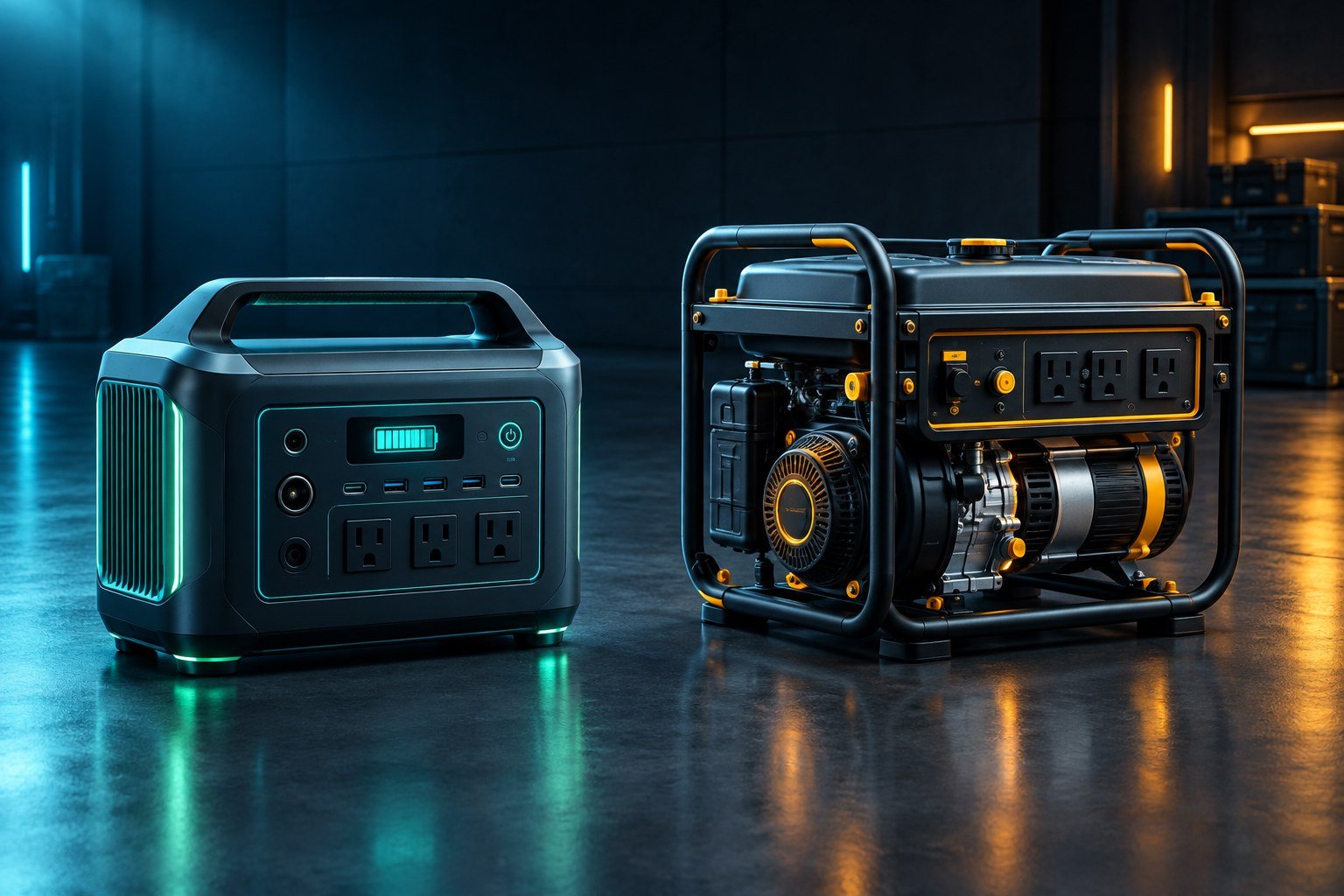
Portable power station vs generator at a glance
| Factor | Portable power station | Fuel generator |
|---|---|---|
| Energy source | Rechargeable battery | Gasoline, diesel, propane or natural gas |
| Best use | Electronics, CPAP, routers, lights and modest appliance loads | Large appliances, pumps, tools and extended outages |
| Indoor operation | Generally possible when used according to the product manual | Never operate a combustion generator indoors or in a garage |
| Noise | Very quiet apart from cooling fans | Engine and exhaust noise |
| Runtime extension | Recharge from grid, vehicle or compatible solar | Refuel after shutdown and cooling according to the manual |
| Maintenance | Battery care, charging and storage checks | Fuel, oil, filters, engine exercise and storage maintenance |
| High-power loads | Limited by inverter continuous and surge ratings | Often available with much higher running and surge output |
How each option supplies power
Portable power station
Battery cells store energy in watt-hours. A battery-management system protects the cells, while an inverter converts DC energy into household AC power. USB and regulated DC outputs may avoid some inverter losses.
Capacity controls how much energy is available; continuous and surge ratings control what equipment can be started and operated.
Fuel generator
An engine converts fuel energy into mechanical rotation, and an alternator produces electricity. Output can continue as long as the machine remains within its duty limits and fuel is safely available.
Running watts, surge watts and the fuel-consumption curve matter more than the largest number printed on the box.
Runtime: stored watt-hours versus stored fuel
A power station has a finite battery. Its practical AC runtime depends on usable capacity, inverter efficiency and internal idle draw.
Example: a 1,000 Wh station with 90% usable capacity, 85% inverter efficiency and 5 W idle draw powering a 100 W load lasts about 7.34 hours.
A generator is better modeled from usable fuel and its consumption rate at the expected electrical load.
A 20 L tank with a 10% reserve provides 18 L of usable fuel. At an adjusted rate of 2.2 L per hour, the planning estimate is about 8.2 hours. Actual consumption changes with generator design, load, temperature, altitude and maintenance.
Output and startup surge
Both systems must pass two checks before runtime matters:
- Continuous output: the normal running load must remain below the rated continuous watts.
- Startup output: compressors, pumps and motors may briefly demand several times their normal running watts.
Safety and indoor use
A battery power station does not produce engine exhaust at the point of use, but it still requires correct ventilation, dry operating conditions, undamaged cables and operation within the manufacturer’s temperature, charging and output limits.
Which one is better for common situations?
Apartment or indoor electronics
A power station is normally the practical choice because it is quiet and has no combustion exhaust. Check whether its battery is large enough for the required outage duration.
Refrigerator and freezer
Either can work. The power station must pass compressor surge and daily-energy checks. A generator needs safe placement, enough output and sufficient fuel.
CPAP and overnight medical equipment
A compatible battery system is generally quieter and easier to keep beside the sleeping area. Verify DC-cable compatibility, humidifier load and required reserve. Maintain a medically appropriate backup plan.
Well pump, large air conditioner or workshop tools
A correctly sized generator often provides more practical continuous and surge power. Installation, grounding, transfer equipment and fuel storage may require qualified professional help.
Camping and vehicle travel
A power station works well for lights, cameras, laptops, small coolers and low-power cooking devices. Solar can extend use, but daily production is weather-dependent.
Multi-day home outage
A generator can be refueled, while a power station needs grid, vehicle or solar recharge. A hybrid setup can cover quiet nighttime loads with a battery and use a generator for heavy loads and recharging.
Cost is more than the purchase price
For a power station, compare purchase cost, usable watt-hours, inverter output, expected cycle life, solar-controller limits and eventual battery degradation. For a generator, include fuel, oil, service parts, safe storage, cables, transfer equipment and periodic engine maintenance.
The cheaper device is the one that meets the real load and duration without forcing an immediate second purchase. Oversizing also costs money, so calculate before choosing.
A practical five-step decision
- List essential devices. Record running watts, startup watts and hours of use.
- Add simultaneous loads. Decide which devices truly need to operate together.
- Check output compatibility. Compare continuous watts and the largest likely startup event.
- Estimate required duration. Calculate battery runtime or fuel runtime with reserves and real losses.
- Check the operating environment. Consider indoor use, noise, exhaust, weather, fuel availability, charging and storage.
When a hybrid setup makes sense
A battery and generator can complement each other. The battery can run routers, lights, CPAP equipment and small electronics quietly overnight. A generator can handle high-power daytime loads and recharge the battery when solar or the grid is unavailable.
Do not connect systems together unless the equipment explicitly supports that configuration. Observe charge-input limits, generator waveform requirements, grounding instructions and transfer-switch rules.
Compare your real setup
Use your own appliance watts, startup surge, battery capacity and generator fuel rate instead of choosing from marketing labels alone.
Frequently asked questions
Can a portable power station replace a generator?
For modest loads and shorter outages, sometimes. It cannot be assumed to replace a high-output generator for large motors, electric heating, central air conditioning or long outages without substantial battery capacity and recharging.
Which lasts longer during an outage?
It depends on stored battery energy, available fuel, load and recharge or refueling access. A generator can often continue longer when fuel is available; a power station can operate quietly but must eventually be recharged.
Which is cheaper to run?
A charged battery can have low operating cost, especially when recharged from existing solar, but the battery has a finite cycle life. Generator cost depends on fuel consumption, local fuel price and maintenance. Compare the whole use case rather than one hour of operation.
Can either system run a refrigerator?
Yes, when continuous watts, compressor startup surge and required energy duration all fit. Use measured daily refrigerator energy when possible rather than multiplying compressor watts by 24 hours.
Is a solar generator actually a generator?
The term usually describes a portable battery power station paired with solar panels. It stores and converts electricity; it does not generate electricity from fuel through an engine.
Bottom line
Choose a portable power station for quiet, low-maintenance backup where its watt-hours and inverter ratings fit the load. Choose a fuel generator for larger loads or longer operation where fuel, maintenance and safe outdoor placement are realistic. For many households, a carefully sized hybrid system offers the strongest balance.
Learn how a portable power station works, calculate what size portable power station you need, compare battery life and runtime, and review how PowerRuntime calculations are built.