
Quick answer: most household refrigerators draw power only while the compressor is running. The useful numbers are running watts, brief startup surge and total energy in kWh per day—not one wattage figure treated as continuous for 24 hours.
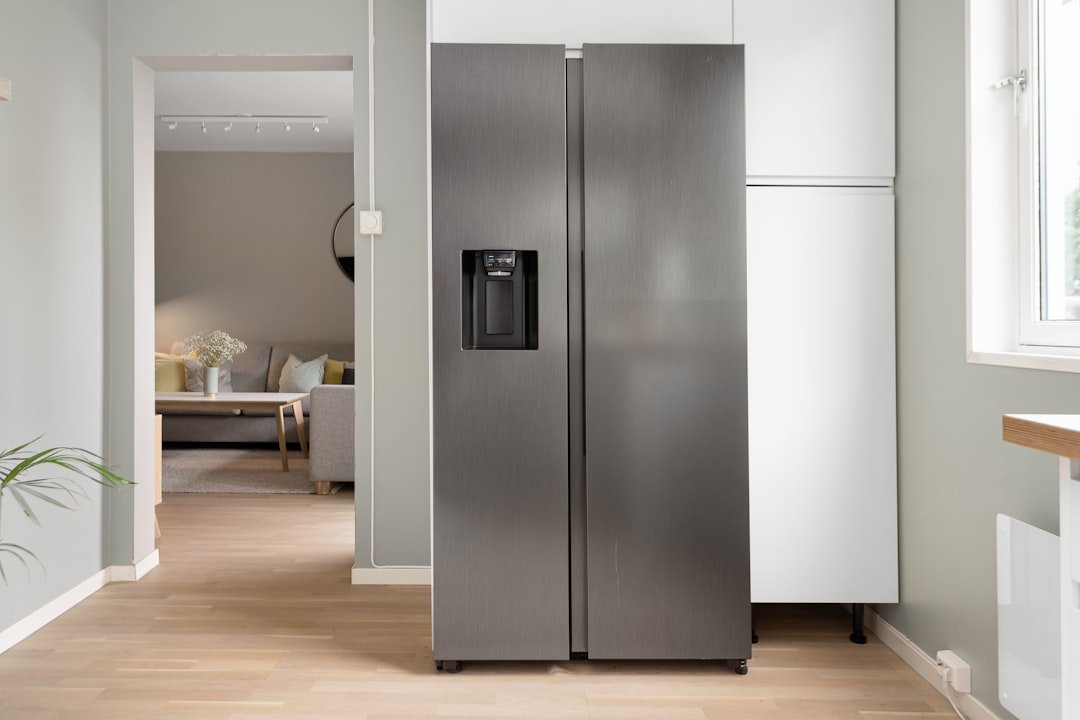
A refrigerator may show 150 watts while its compressor runs, but that does not mean it consumes 150 watts every minute of the day. Once the cabinet reaches temperature, the compressor cycles off. Room heat, door openings, food load, thermostat setting, defrost heaters and appliance age all change the duty cycle.
This guide explains how to estimate refrigerator watts without confusing power with energy. If you already know your fridge’s daily kWh, use our refrigerator backup calculator for a battery-runtime estimate that includes cycling, heat and startup surge.
Typical refrigerator wattage ranges
The figures below are planning ranges, not substitutes for the appliance label or a power-meter reading. Two refrigerators of the same size can use different compressors, defrost systems and controls.
| Refrigerator type | Typical running watts | Planning startup surge | Best measurement |
|---|---|---|---|
| Compact or mini fridge | 50–100 W | 200–600 W | Plug-in watt meter |
| Standard top-freezer | 100–200 W | 600–1,200 W | EnergyGuide kWh/year |
| Large side-by-side | 150–250 W | 800–1,500 W | Meter plus label |
| French-door refrigerator | 150–300 W | 900–1,800 W | Meter plus label |
| Older refrigerator | Highly variable | Verify at startup | 24–72 hour measurement |
For compact units, see the separate mini refrigerator wattage guide. For starting estimates across other devices, use the home appliance wattage chart.
Running watts, startup watts and daily energy
Running watts
Running watts are the electrical power drawn while the compressor is operating. Lights, fans, ice makers and defrost heaters can temporarily change the reading. This number determines whether an inverter can carry the refrigerator after startup.
Startup surge
A compressor motor can demand several times its normal running power for a short moment. Battery capacity does not prove compatibility: a large battery connected to an undersized inverter may still fail to start the compressor. Check both the inverter’s continuous rating and its surge rating.
Daily kWh
Kilowatt-hours measure energy over time. Daily kWh automatically captures compressor cycling and is normally the better number for estimating backup duration. ENERGY STAR product information and the yellow EnergyGuide label can help compare annual energy consumption, while a plug-in meter reflects your actual room and usage conditions.
Convert the EnergyGuide label to daily use
If the label lists annual energy consumption, divide it by 365:
Example: a refrigerator rated at 438 kWh per year uses an average of:
This is an annual standardized estimate, not a guarantee for every home. A hot garage, damaged door gasket or frequent opening can raise actual use. The U.S. Federal Trade Commission explains how to read the EnergyGuide label, and ENERGY STAR provides refrigerator efficiency information.
Estimate watts from a power meter
- Connect the refrigerator to a correctly rated plug-in energy meter.
- Record the running wattage after the compressor starts.
- Measure energy for at least 24 hours; 72 hours is better for variable weather and defrost cycles.
- Do not use a typical consumer meter to capture a very short surge unless the meter explicitly supports inrush measurement.
- Use measured kWh/day for runtime and the manufacturer’s startup specification for inverter selection.
Worked battery-backup example
Suppose a refrigerator consumes 1.20 kWh per day. A power station has 2,048 Wh nameplate capacity, 90% usable capacity and 88% inverter efficiency.
The result is an estimate. Battery-management reserves, inverter idle draw, high temperature and refrigerator behavior can reduce real runtime. The inverter must also handle the compressor’s continuous and startup power independently.
Calculate your refrigerator runtime
Enter measured kWh/day or use running watts with a duty cycle, then verify inverter surge compatibility.
What increases refrigerator electricity use?
- High ambient temperature: the compressor runs longer when heat enters the cabinet faster.
- Frequent door openings: warm, humid air adds a new cooling load.
- Dirty condenser coils: restricted heat rejection can reduce efficiency.
- Poor door seals: damaged gaskets allow continuous heat and moisture entry.
- Defrost cycles: heaters can create short high-power periods not represented by compressor watts.
- Inappropriate thermostat settings: colder settings usually require more energy.
Common refrigerator-wattage mistakes
- Using maximum nameplate watts as if they run continuously.
- Ignoring startup surge when choosing a power station or inverter.
- Confusing watts with watt-hours.
- Using a generic 30% duty cycle instead of measured daily energy.
- Assuming a new refrigerator and a 20-year-old refrigerator use the same amount.
- Quoting an exact runtime without allowing for temperature and conversion losses.
Frequently asked questions
Can a 1,000-watt inverter run a refrigerator?
Possibly, but the watt rating alone is not enough. Compare the refrigerator’s measured running load and startup requirement with both the inverter’s continuous and surge ratings. Leave headroom rather than operating at the limit.
How many watts does a refrigerator use per day?
Watts are instantaneous power, so daily consumption should be stated in watt-hours or kilowatt-hours. Divide the EnergyGuide annual kWh by 365 or measure the appliance for at least 24 hours.
Will a power station damage a refrigerator?
A correctly sized pure-sine-wave power station is generally the safer choice for compressor electronics. Verify voltage, frequency, grounding requirements and the refrigerator manufacturer’s instructions.
How long will a refrigerator stay cold without power?
Temperature holdover is different from electrical runtime and depends on cabinet insulation, room temperature, food load and door openings. Follow local food-safety guidance during an outage.
Planning a larger off-grid system? Use the solar battery bank size calculator to convert daily energy and autonomy into battery kWh, Ah, module count and solar-array size.
Pingback: How to Size a Solar Battery Bank: Step-by-Step Guide