
Quick answer: size a battery bank from measured daily energy, required backup days, system losses, usable depth of discharge, temperature and reserve. Do not choose capacity from inverter watts alone.
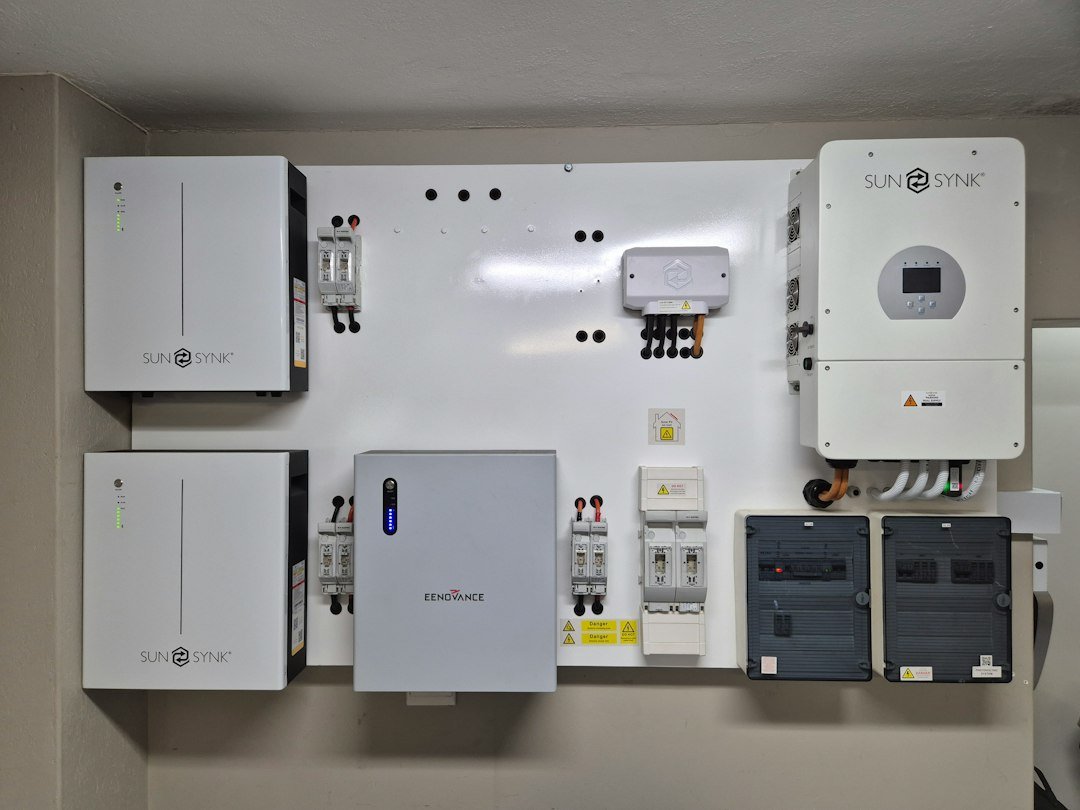
Solar battery sizing is an energy calculation first and an electrical design second. Daily kilowatt-hours determine how much stored energy you need. Inverter ratings, startup surge, module voltage, current, wiring and protection determine whether the bank can deliver that energy safely.
This guide shows the calculation transparently. For instant results, use the solar battery bank size calculator, which also converts the result to amp-hours, battery count, series/parallel layout and minimum solar-array power.
Step 1: Measure daily energy use
Start with the loads that must operate during an outage or off-grid period. The best input is measured kWh per day from inverter logs, utility data or plug-in energy meters. Appliance wattage labels often show a maximum rather than typical consumption.
For cycling loads such as refrigerators, use measured daily kWh instead of multiplying compressor running watts by 24 hours. Our refrigerator wattage guide explains the difference.
Step 2: Choose backup days
Autonomy is the time the battery must support the selected loads without useful charging. One day may be suitable where grid power or dependable sun returns daily. Two or more days provide more resilience but increase battery cost and weight quickly.
Step 3: Include system efficiency
The loads receive less energy than the battery releases because the inverter, wiring and battery management system consume energy. If the loads require 5 kWh/day and the system is 90% efficient, the battery must supply:
Efficiency belongs on the energy demanded from the battery. Multiplying capacity by efficiency can give the same result in a simple one-step runtime formula, but dividing the load keeps multi-stage sizing clearer and reduces accounting mistakes.
Step 4: Apply depth of discharge and temperature
Depth of discharge is the planned usable share of nameplate capacity. The correct value comes from the battery manufacturer’s operating and warranty limits—not a universal internet number.
| Chemistry | Conservative planning DoD | Main consideration | Use manufacturer data? |
|---|---|---|---|
| LiFePO4 | 80% | Good cycle life and large usable fraction | Yes |
| Lithium-ion | 80–85% | BMS limits and thermal management | Yes |
| AGM lead-acid | 50% | Deeper cycling can shorten life | Yes |
| Flooded lead-acid | 50% | Maintenance, ventilation and discharge rate | Yes |
Temperature can reduce available capacity, especially outside the battery’s preferred operating range. A 10% temperature derating means using a 0.90 temperature factor.
Step 5: Add a design reserve
A reserve allows for battery aging, imperfect load estimates and modest future growth. Ten to twenty percent is a common planning range, but oversized reserves increase cost. Keep reserve separate from depth of discharge so each assumption remains visible.
The complete battery-bank formula
Worked example
- Daily load: 5 kWh
- Backup autonomy: 2 days
- System efficiency: 90%
- Design reserve: 15%
- LiFePO4 usable DoD: 80%
- Temperature derating: 10% (factor 0.90)
Result: ((5,000 ÷ 0.90) × 2 × 1.15) ÷ (0.80 × 0.90) = 17,747 Wh. Round up to a practical target of approximately 18 kWh nameplate capacity.
Convert kWh to amp-hours
Amp-hours depend on bank voltage. The same energy requires less current at a higher system voltage.
For the example above: 17,747 Wh ÷ 48 V = approximately 370 Ah. At 24 V, the same energy would require about 739 Ah. Voltage selection affects current, cable size, equipment compatibility and protection design; it is not merely a calculator preference.
Calculate series and parallel battery count
Series connections raise voltage while amp-hours remain unchanged. Parallel strings raise amp-hour capacity while voltage remains unchanged.
Using 12 V, 100 Ah modules for a 48 V bank:
48 V ÷ 12 V = 4 batteries in series.
370 Ah ÷ 100 Ah = 3.7, so round up to 4 strings.
The physical plan is 4 batteries in series × 4 parallel strings = 16 batteries. Installed nameplate capacity is 16 × 12 V × 100 Ah = 19.2 kWh, which exceeds the 18 kWh target.
Size the supporting solar array
A simple planning estimate divides the battery-side daily energy plus reserve by peak sun hours and solar charging efficiency:
With 5 peak sun hours and 85% charge efficiency, the example needs approximately 1,510 W of array power. Real production changes with climate, season, tilt, shading, module temperature and controller limits. Use location-specific modelling such as NREL PVWatts before purchasing equipment.
Battery capacity and inverter power are different
A battery bank can store enough energy for two days while an undersized inverter still fails instantly. Verify:
- Simultaneous continuous load in watts.
- Largest motor or compressor startup surge.
- Inverter continuous and short-duration surge ratings.
- Battery and BMS discharge-current limits.
- DC cable, fuse, disconnect and busbar ratings.
Calculate your solar battery bank
Enter daily kWh, backup days, chemistry, voltage, temperature and reserve, then get kWh, Ah, module count and array size.
Already know your battery size? Use the solar panel battery charging time calculator to estimate peak-sun hours, solar days and the active charging bottleneck.
Common sizing mistakes
- Using inverter watts as battery capacity.
- Confusing kW with kWh or Ah with Wh.
- Ignoring conversion losses and inverter idle consumption.
- Applying 100% depth of discharge to every chemistry.
- Ignoring cold or hot temperature derating.
- Rounding battery count down instead of up.
- Assuming average solar production is guaranteed every day.
- Designing series/parallel wiring without matching modules and protection.
Frequently asked questions
How many batteries do I need for 10 kWh per day?
Daily energy alone is insufficient. The answer also depends on backup days, efficiency, depth of discharge, temperature, reserve, bank voltage and each module’s voltage and Ah rating.
Is a 10 kWh battery actually 10 kWh usable?
Not necessarily. Usable energy depends on permitted depth of discharge, battery-management reserves, temperature, age and discharge rate.
Should I use 12 V, 24 V or 48 V?
Higher voltage reduces current for the same power, but every component must be compatible. Small systems may use 12 V or 24 V; larger inverter systems often use 48 V. Have the final design checked by a qualified professional.
Can I mix batteries of different capacities or ages?
Mixing modules can create imbalance and unequal current sharing. Follow the manufacturer’s approved configuration and do not assume unlike batteries can be safely combined.
For runtime from an existing battery rather than sizing a new solar bank, use the battery backup time calculator.