
The difficult part is that a refrigerator does not draw one fixed wattage all day. Its compressor cycles, startup demand is brief but high, and real consumption changes with room temperature, door openings, thermostat setting, age and model.
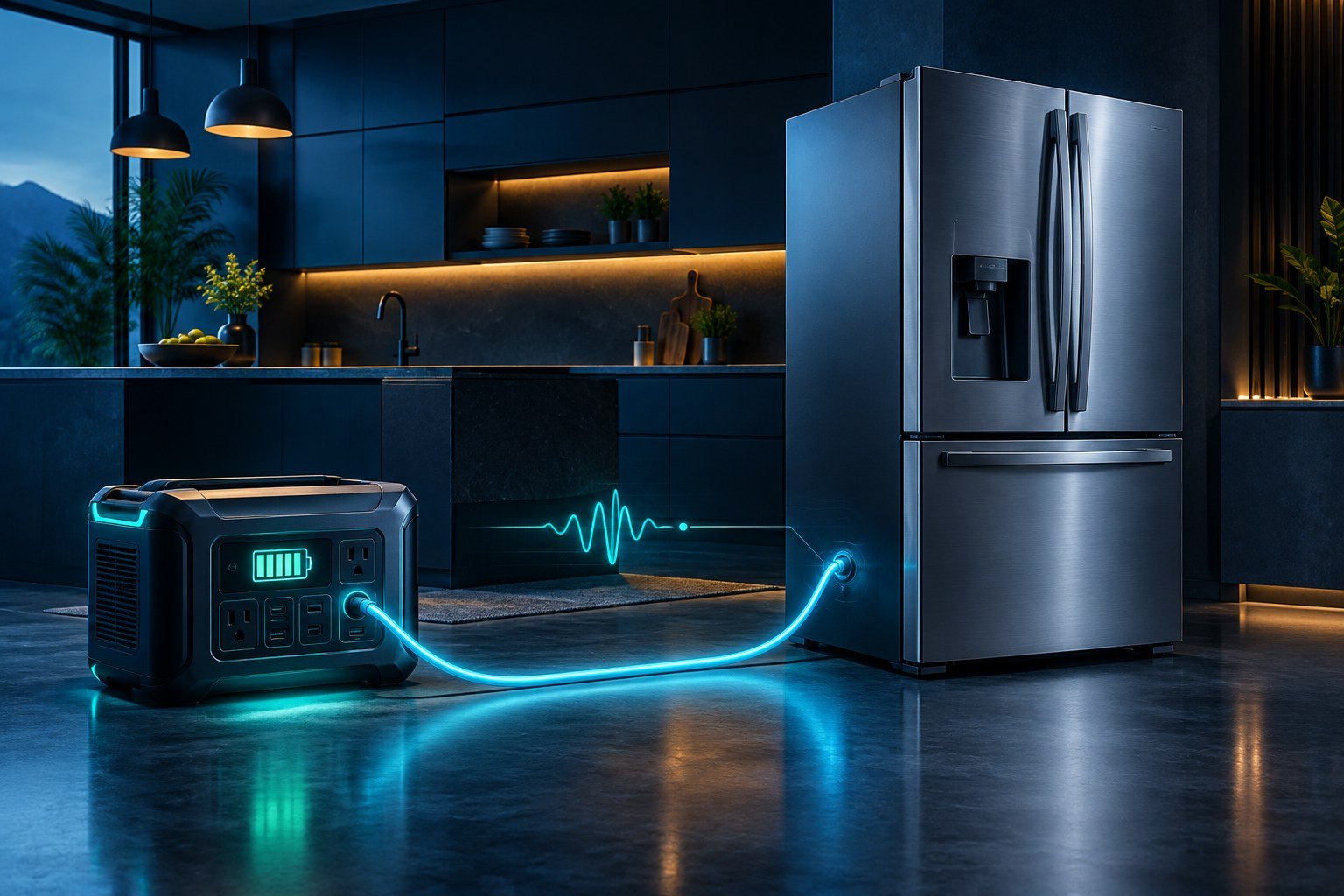
The three checks your power station must pass
1. Continuous output
The station’s AC inverter must exceed the refrigerator’s normal running watts plus any other devices operating simultaneously.
2. Startup surge
The compressor can demand several times its running power for a short moment. The station must tolerate that event without shutting down.
3. Usable battery energy
Battery watt-hours determine duration after usable-capacity limits, inverter losses and the station’s own idle draw are included.
4. Food-safety window
Backup planning should protect food, not merely keep the display illuminated. Use an appliance thermometer and follow official food-safety guidance.
Why refrigerator watts are easy to calculate incorrectly
The power label may show compressor running watts, maximum input or electrical ratings—not average 24-hour consumption. Multiplying 150 running watts by 24 hours assumes the compressor never switches off, which can overstate daily energy by several times.
For battery sizing, the best input is measured energy in kilowatt-hours over a full day. A plug-in energy meter captures compressor cycling, defrost heaters, fans and standby electronics. The appliance’s EnergyGuide annual consumption can also be converted to a daily estimate.
The U.S. Department of Energy also provides a refrigerator and freezer energy-rating search tool for estimating model consumption when label information is unavailable.
Estimate runtime from daily energy
If your refrigerator uses 1.2 kWh per day, its average delivered load is 50 W:
For a 1,000 Wh station with 90% usable capacity, 85% inverter efficiency and 5 W of inverter idle draw:
Estimate required capacity for a full day
To supply 1.2 kWh of refrigerator energy for 24 hours with a 90% usable fraction and 85% AC efficiency:
Adding a 20% planning reserve produces about 1,883 Wh, so the practical shopping class is approximately 2,000 Wh—provided its inverter also passes the compressor startup test.
Worked estimate using running watts and duty cycle
When no daily energy measurement is available, estimate average load from compressor running watts and duty cycle. Suppose a refrigerator draws 150 W while running and the compressor operates 35% of the time:
Over 12 hours, that equals 630 Wh delivered to the refrigerator. With 90% usable battery capacity and 85% inverter efficiency, the minimum nominal battery capacity is about 824 Wh before reserve and inverter idle draw. A 1,000–1,200 Wh class station may be a sensible starting point for this example, but surge compatibility remains mandatory.
How to check compressor startup surge
- Find the refrigerator’s specifications. Look for starting watts, locked-rotor amps, maximum current or manufacturer guidance.
- Check the power station ratings. Compare both continuous AC output and surge output, including any time limit attached to the surge claim.
- Include other simultaneous loads. A compressor may start while the router, lights or another appliance is already operating.
- Test before an emergency. Start the refrigerator from the charged station and observe whether overload protection activates.
- Use measured startup data when possible. A suitable meter with peak or inrush capture is more useful than guessing from running watts.
Do not assume a station labeled “1,000 W” will start every refrigerator. Different inverter designs handle short peaks differently, and compressor behavior varies by refrigerator.
Typical planning scenarios
| Scenario | Example planning class | Critical check |
|---|---|---|
| Compact efficient refrigerator for several hours | 500–1,000 Wh | Measured daily energy and compressor surge |
| Standard refrigerator for roughly half a day | 1,000–1,500 Wh | Hot-weather duty cycle and inverter idle draw |
| Standard refrigerator for about one day | 1,500–2,500 Wh | Daily kWh, reserve and startup output |
| Refrigerator plus router, lights and charging | Add every device’s watt-hours | Simultaneous running load and largest startup event |
| Multi-day outage | Battery plus realistic recharge plan | Solar/grid/generator energy available each day |
These are orientation ranges, not universal recommendations. A small efficient refrigerator can use less energy than an older compact model, while extreme heat can substantially increase cycling.
Will a 500 Wh power station run a refrigerator?
It may start and run an efficient refrigerator if the inverter handles surge, but duration is usually limited. With 450 Wh usable and the same 50 W average refrigerator load, 85% efficiency and 5 W idle draw, the estimate is roughly seven hours. Other loads reduce that time.
Will a 1,000 Wh power station run a refrigerator?
Often yes, provided the surge rating is adequate. In the 1.2 kWh/day example above, the estimate is about 14 hours. A refrigerator consuming 2 kWh/day would last much less, while a highly efficient unit could last longer.
Will a 2,000 Wh power station run a refrigerator?
A 2,000 Wh class station can often support a refrigerator for roughly a day in a moderate-use example, while leaving some reserve. The exact result still depends on usable capacity, efficiency, idle draw, weather and door openings.
AC versus DC refrigerators
A normal household refrigerator uses the station’s AC inverter. Compatible portable DC refrigerators can avoid the AC conversion stage, often reducing losses. Never improvise voltage or connectors: use an approved cable and remain within the refrigerator and power station specifications.
How solar charging changes the calculation
Solar does not automatically make runtime unlimited. Compare daily refrigerator energy with realistic daily solar harvest after panel, controller and charging losses. A 200 W panel does not produce 200 W throughout every daylight hour; cloud, shade, heat, angle and the station’s input limit matter.
If the system harvests less energy than it uses, the battery will eventually empty even though solar is connected.
Food safety during an outage
Restoring intermittent power does not automatically make food safe if it has already spent too long above a safe temperature. Treat the power station as part of a food-safety plan, not a substitute for temperature monitoring.
Common mistakes
- Multiplying compressor running watts by 24 hours.
- Using average watts but ignoring startup surge.
- Assuming all advertised watt-hours are usable at the AC outlet.
- Ignoring inverter idle power during a low average load.
- Using one mild-weather duty cycle for every season.
- Adding solar-panel watts without estimating daily solar energy.
- Running extra appliances without recalculating simultaneous load.
- Waiting for an outage before testing the refrigerator and station together.
Calculate your refrigerator runtime
Use measured daily energy or a realistic running-watt and duty-cycle estimate, then verify startup surge separately.
Frequently asked questions
Can a portable power station damage a refrigerator?
A compatible pure-sine-wave output within the refrigerator’s voltage, frequency, continuous and surge requirements should operate normally. An undersized or incompatible inverter may shut down or cause unreliable starting. Follow both manufacturers’ instructions.
Should I keep the power station plugged into the refrigerator continuously?
Only use pass-through or UPS-style operation when the station manufacturer explicitly supports it for that purpose. Consider switchover time, battery cycling and grounding instructions.
How do I find my refrigerator’s daily energy use?
Measure it for at least 24 hours with an energy meter, or divide the EnergyGuide annual kWh by 365. Measure during representative room temperatures and usage.
Why does the power station shut off when the compressor starts?
The startup surge may exceed the inverter’s short-duration output, or another load may already be consuming part of the available power. Check both continuous and surge limits.
Can I run a freezer at the same time?
Yes only when combined running watts, overlapping startup events and total daily energy fit the station. Calculate both appliances rather than doubling a refrigerator estimate.
Bottom line
A portable power station can run a refrigerator when it passes all three engineering checks: adequate continuous watts, adequate compressor surge and enough usable watt-hours. Measure daily energy when possible, calculate losses and reserve honestly, then test the full setup before relying on it during an outage.
Check how many watts a refrigerator uses, calculate what size portable power station you need, and compare battery and generator backup.